❋ NEW ❋
❋ AS SEEN ON TIK TOK❋
❋ NEW ❋ ❋ AS SEEN ON TIK TOK❋
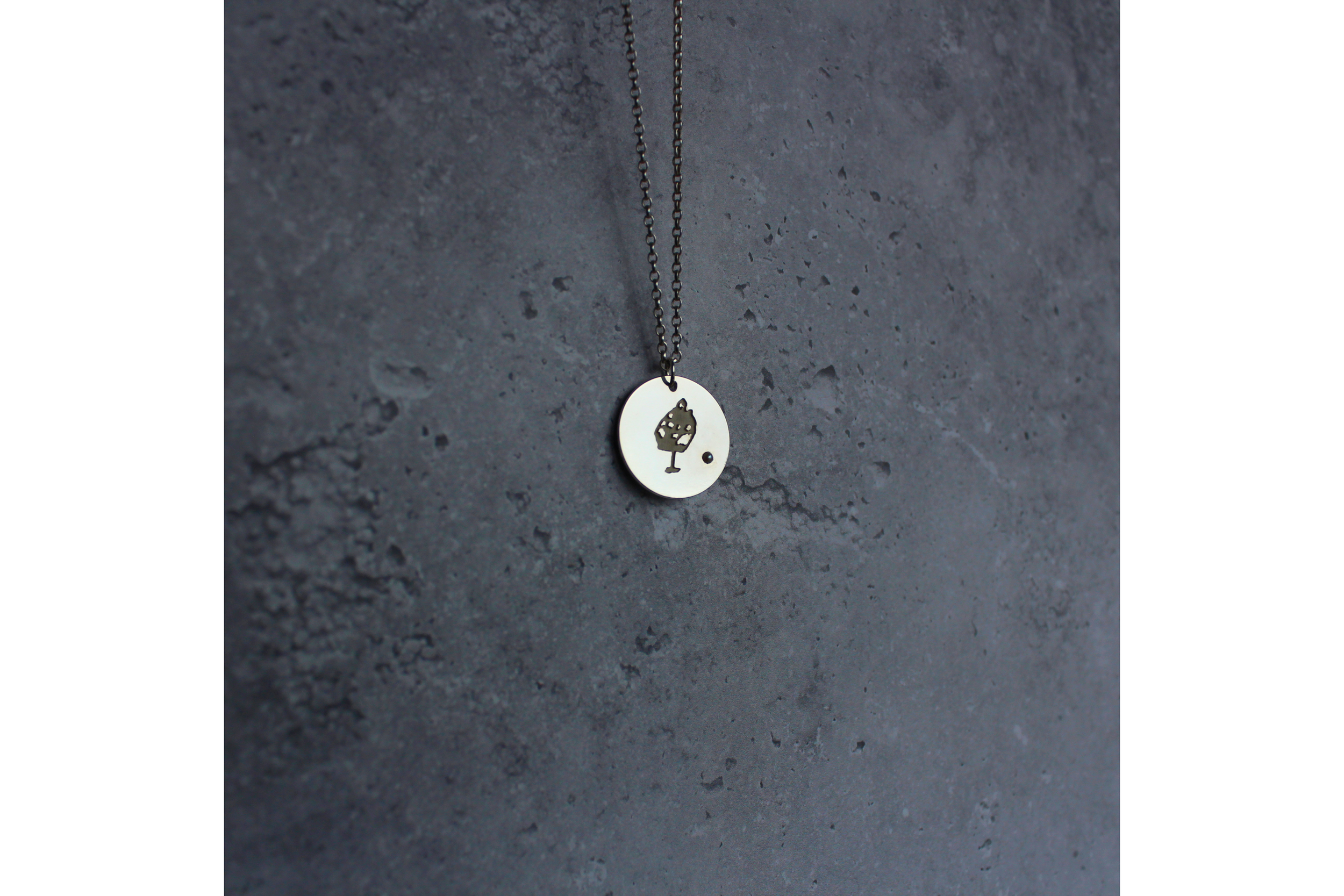
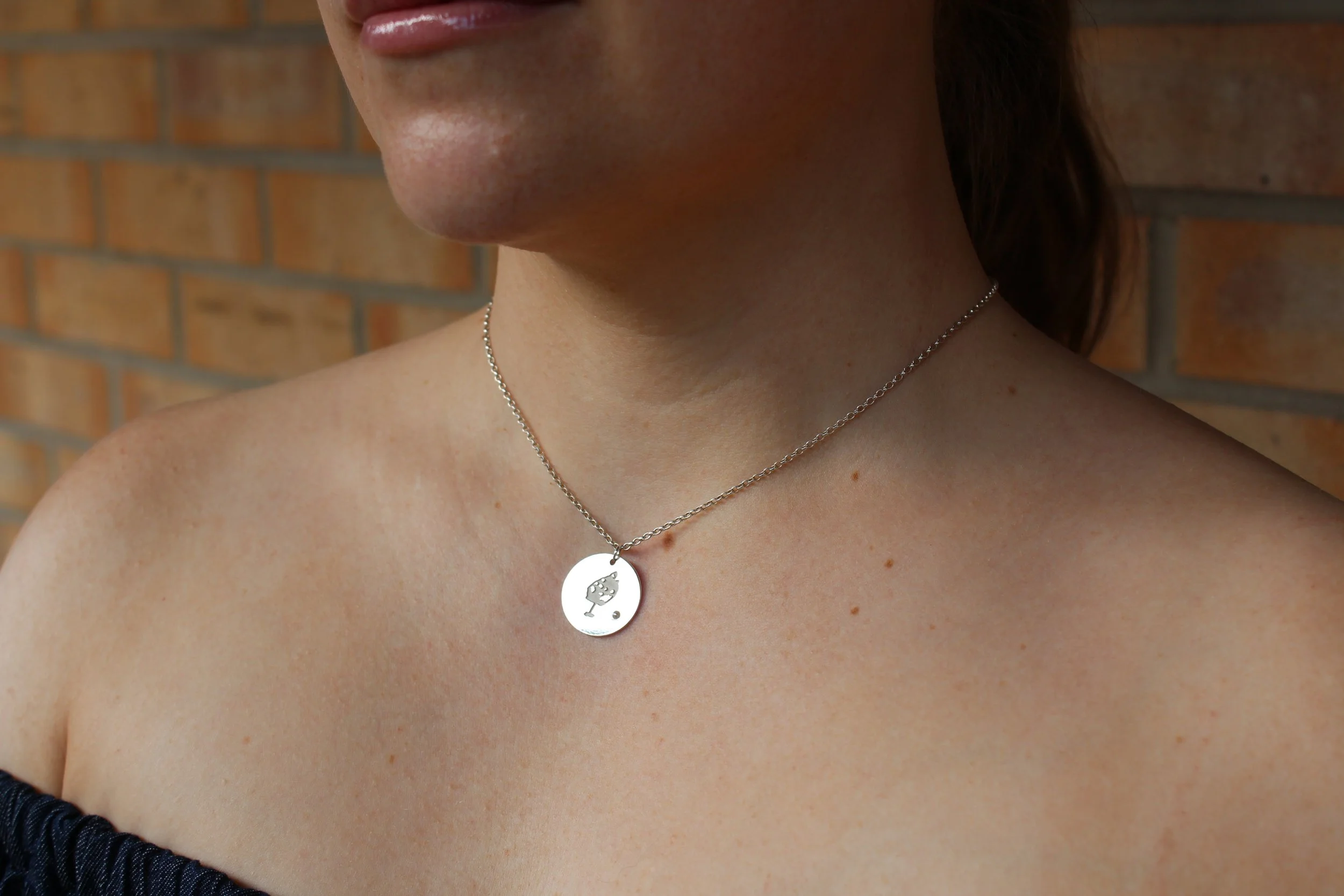
Anne Boleyn astrolabe and signature pendant, set with pearl
20mm disc, sterling silver or gold vermeil
For those who are entirely, unapologetically themselves.
The source:
This pendant carries two things from Anne Boleyn's Book of Hours, her personal symbol and her own signature.
On the front: the astrolabe — the same symbol Anne drew alongside her inscription Le temps viendra on that page of her Book of Hours, and which also appears in the Ecclesiastes manuscript associated with her, shown at Hever Castle for the first time this century. Scholars understand the astrolabe not as an astronomical reference but as Anne's most personal mark — an emblem of time, of self-knowledge, of the moral weight of living within finite days. It is the symbol she chose before she adopted the crowned falcon of her queenship. Before the world knew who she would become, this is the mark she made.
On the reverse: her signature, as she wrote it. Anne Boleyn.
Together: her private symbol and her name. I am this. I know what time it is.
The stone:
The pearl is historically exact. Anne Boleyn's documented jewellery collection was notable for its pearls — worn in ropes, sewn into hoods, and set into pendants. She appears in portraits with pearl necklaces at her throat. In the Tudor period, pearls were the stone of queens: rare, organic, formed through genuine process, lustrous without being showy. They were also, in English folk tradition, associated with emotional truth — things that form slowly, through real experience, from something that began as an intrusion and became something precious.
The talisman:
Wear this as a declaration of self-knowledge. Knowing who you are, and being willing to put your name to it.
Materials:
Double-sided engraved 20mm disc pendant, pearl, sterling silver or gold vermeil
Available in: Sterling silver / Gold Vermeil
All of our pieces are handmade in London to order. Current lead time is two weeks.
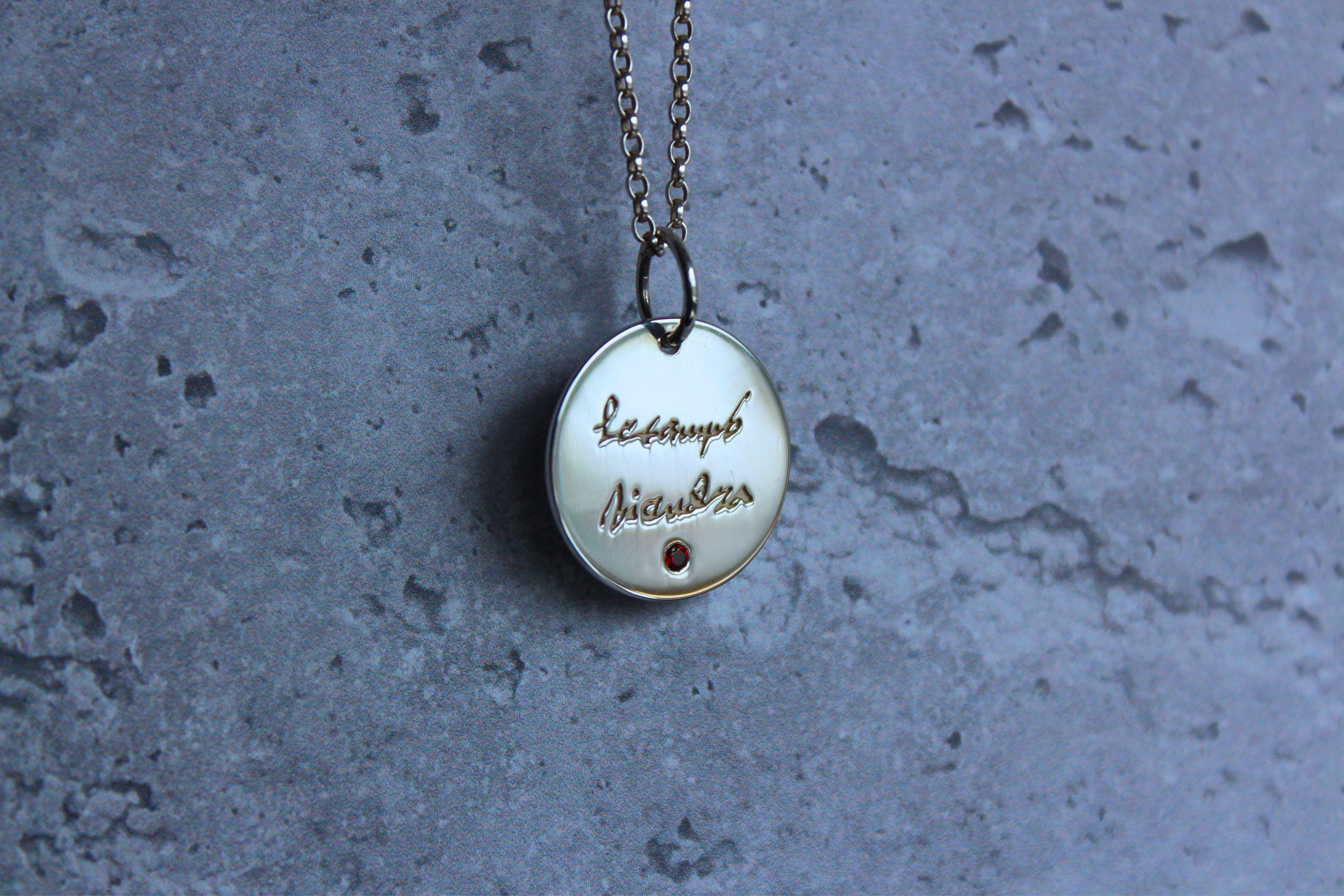
Anne Boleyn handwriting pendant, set with faceted garnet
20mm disc, sterling silver or gold vermeil
For those who know their moment is coming.
The source:
The inscription on this pendant is taken directly from Anne Boleyn's Book of Hours, held at Hever Castle. On a single, deeply personal page, Anne wrote in her own hand: Le temps viendra. Je Anne Boleyn. The time will come. I, Anne Boleyn.
She wrote this beneath an illumination of the Last Judgement. Alongside the inscription she drew an astrolabe — a medieval instrument for measuring time and the position of the sun, used here not as a scientific reference but as a private emblem of time passing, mortality, and divine reckoning. Hever Castle's own scholars describe it as a meditation on temporality: the certainty that time is finite, that judgement comes, and that it will come for everyone.
We don't know exactly what Anne meant by it. We know where she wrote it. We know what happened to her afterward. We know that her statement is one of absolute certainty: the time will come.
The stone:
The garnet is historically deliberate. Garnet was among the most valued stones of the Tudor period, appearing consistently in portraits of court women and set in the heavy gold necklaces and pendants that marked status, favour, and endurance. The stone's deep red, its documented associations with vitality and the courage required for difficult journeys, and its durability — 6.5–7.5 on the Mohs scale — made it the only honest choice for a piece bearing these words.
Untreated. The colour is the stone's own.
The talisman:
Wear this in the periods of waiting that require patience without passivity. When you know what's coming but cannot yet make it arrive. A reminder, in Anne Boleyn's own words, that timing is not the same as defeat.
Materials:
Engraved 20mm disc pendant, faceted garnet, sterling silver or gold vermeil
Available in: Sterling silver / Gold Vermeil
All of our pieces are handmade in London to order. Current lead time is two weeks.
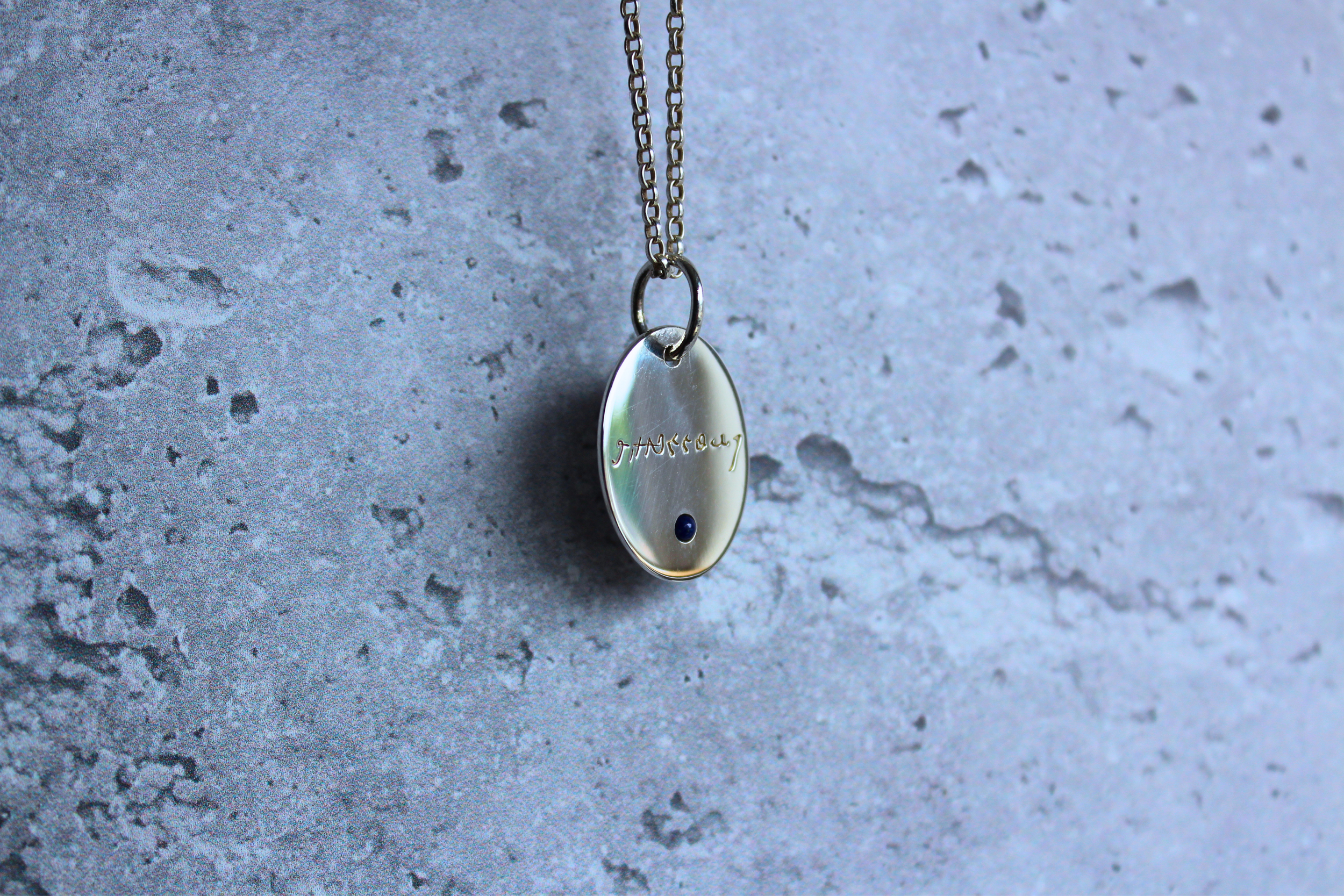
Cleopatra handwriting pendant, set with a lapis lazuli cabochon
19.5mm × 12mm oval pendant, available in sterling silver or gold vermeil
For those who make things happen.
The source:
This pendant carries what is believed to be the only surviving sample of Cleopatra's handwriting in existence.
The document is Papyrus Bingen 45 — formally known as Papyrus Berlin 25239, held in the Neues Museum in Berlin. A royal decree dated February 23, 33 BC, it’s a royal decree granting a tax exemption to Publius Cadidius, a close associate of Marc Antony. The decree permits him to export 10,000 artabas of wheat and import 5,000 amphorae of wine per year without paying customs duties.
Most of the document was written by a court scribe. But at the bottom, in different handwriting, appears one word written in Greek:γινέσθωι. Ginesthoi. So be it. Make it happen.
Historians believe this single word is Cleopatra's handwriting. If so, it’s the last known example of her hand. It has been laser engraved — spelling mistake and all — onto this pendant. An exact replica of her final remaining written word.
The stone:
Lapis lazuli was once the most valuable material in the ancient world. It was prized in the ancient world: ground into ultramarine blue pigment, buried with Tutankhamun and traded across the ancient world from its source in Afghanistan.
In Cleopatra’s egypt, lapis lazuli was considered a stone of royal and divine authority. The deep blue of the stone — which is, in fact, a rock — is dotted with golden pyrite and pale calcite, reminiscent of the night sky.
The talisman:
Wear this when you need to act decisively. Not when you're certain — certainty is a luxury. When the situation requires a single word of authority and you are the only one who can give it. Ginesthoi. Make it so.
Materials:
Engraved oval pendant, lapis lazuli cabochon
Available in sterling silver and gold vermeil
All of our pieces are handmade in London to order. Current lead time is two weeks.
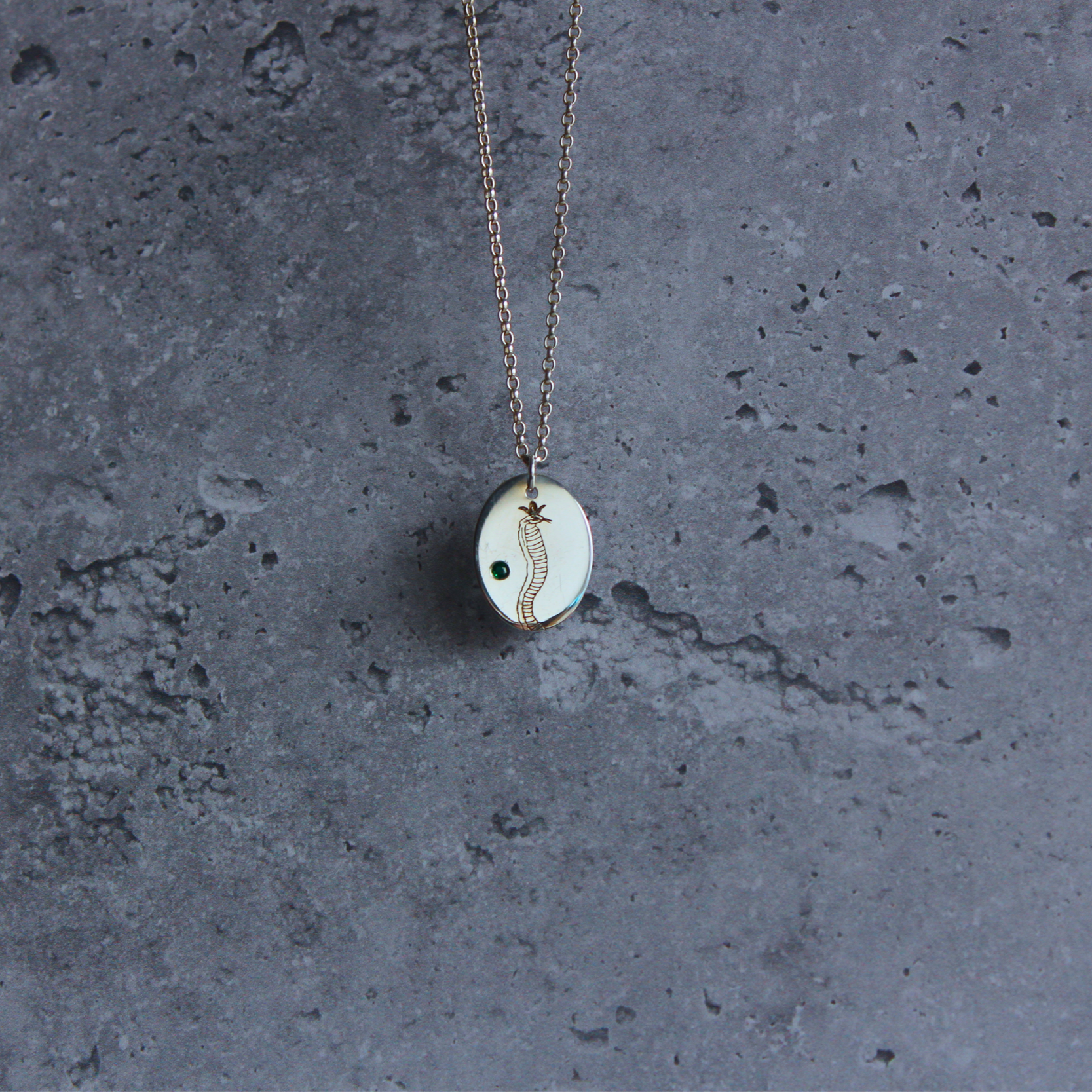
Crowned snake pendant, set with a 2mm emerald cabochon
20mm x 15mm oval pendant in sterling silver or gold vermeil
For those who carry authority without needing to announce it.
The source: The image on this pendant is taken from a painted serpent in the Tigran Tomb, Alexandria, Egypt — a tomb Lucinda visited in person. The Tigran Tomb sits above ground, directly over the famous catacombs of Kom el Shoqafa, and dates to roughly the second century CE. It was found submerged and excavated in 1952. Inside, painted on the short walls flanking the entrance to the burial chamber, two serpents rear upright, each protecting the tomb.
Art historian Marjorie S. Venit, writing in the American Journal of Archaeology (1997), identifies the left serpent — the one engraved on this pendant — as Isis-Thermouthis.
Thermouthis was the Egyptian grain goddess, frequently depicted as a cobra or asp, and closely linked with Isis in Greco-Roman Egypt. Isis-Thermouthis in her serpent form was a guardian, but also brought her people prosperity, fertility and peace.
What makes this image particularly significant is who claimed Isis-Thermouthis. Cleopatra publicly styled herself as the New Isis, a political and religious identity that made her more legible to the Egyptian people. This isn’t a generic protective serpent. Its the goddess Cleopatra claimed, protecting her capital city.
The stone: Egypt's emerald mines are among the oldest in the world, and have been worked since at least 330 BC. Cleopatra was said to be a particular fan of emeralds. According to legend, she wore emeralds and used them to decorate her chambers. She was also said to send emeralds engraved with her own likeness to friends and allies.
The variety of beryl coloured by chromium, emerald is one of the most prized gemstones in the world. This pendant is set with a 2mm emerald cabochon.
The talisman: Wear this as a reminder that sovereignty that doesn't need to announce itself to be real. You wear the crown.
Materials: Engraved pendant, 2mm emerald cabochon. Available in sterling silver or gold vermeil. All pieces are handmade in London to order. Current lead time is two weeks.
About the CollectionThe Inspiration
Most jewellery claiming historical inspiration is vague — a vibe, a colour palette, a half-remembered myth. Forged means something specific: every piece is engraved with an image or words that exist, that have been photographed, catalogued, studied by scholars.
Anne Boleyn's actual handwriting, from a manuscript she held in her own hands. Cleopatra's only surviving autograph, on a tax document signed two years before everything fell apart. A goddess painted on a tomb wall in the city Cleopatra ruled, claimed as her own image.
Forged isn't inspired by history. It's made from it.
The Sources
Anne Boleyn left behind a Book of Hours — a private prayer book, displayed at Hever Castle — containing the only intimate, unguarded glimpse we have of her interior life. On one page: an inscription, a personal symbol, and her own signature. Written before she was queen.
Cleopatra VII left behind a single word, in her own hand, on a piece of administrative bureaucracy: a tax exemption for an ally of Mark Antony. Historians believe it's the only surviving sample of her handwriting in existence. Two years later, Actium and the end of an empire. But first: one word of absolute authority.
Both women are remembered, mostly, for how their stories ended. Forged is interested in something else — the evidence of who they were while they were still deciding what would happen next.
This collection launches on the summer solstice — the longest day, the point of greatest light before the year turns. It felt right for a collection built on women who made the most of the time they had.